
Why Your AC Runs Constantly: What We See on Service Calls

Here’s the short answer most homeowners never hear: a central air conditioner is built to cool your indoor air to about 20°F below the outdoor temperature, not more. So when it’s 100°F outside and your AC runs all afternoon without a break, that’s often the system working exactly as designed, not a breakdown. The team at Quality Heating, Cooling, Plumbing & Electric sees this play out across the Tulsa metro every summer.

That reframe matters because it changes what you do next. Sometimes constant running means nothing is wrong. Other times it points to a real fault that gets more expensive the longer you wait. Knowing which is which saves you a service call you didn’t need, or catches a problem before it wrecks your compressor.

At Quality Heating, Cooling, Plumbing & Electric, we pulled together what our techs actually find on these calls, ranked by how often we see each one. If you’d rather skip the guesswork, you can always reach out for HVAC service in Tulsa and have someone check it in person. But a lot of this you can sort out yourself in a few minutes.

Is It Normal for My AC to Run Nonstop in Extreme Heat?

Yes, in most cases. On the hottest Tulsa afternoons, near-continuous runtime is usually the system at full capacity, not a failure.

Residential AC systems are engineered around a design temperature. According to reporting from NPR, which spoke with HVAC engineers and installers, most new U.S. systems are built to handle a 95°F day. Srinivas Garimella, a mechanical engineering professor at Georgia Tech, told NPR that those hot days are showing up more often, which pushes equipment closer to its limit.

James Barry, who owns a Houston-area HVAC company, put it plainly to NPR: in extreme heat, efficiency drops and the unit “is going to run non-stop.” That’s physics, not a defect.

There’s a deliberate tradeoff baked in here. Systems are typically sized to handle about 98% of expected local conditions, not the hottest 2% of outlier days. Building for those rare extremes would mean a bigger, pricier, less efficient unit running short cycles the rest of the year. So engineers size for the common case on purpose.

What is the 20-degree rule for air conditioning?

The rule of thumb: your AC can pull indoor air down roughly 20°F below what it is outside. We turn this into a quick self-check we call The Quality 20° Check. Keep in mind that 20°F is a general guideline, not a fixed number. The actual gap your system can hold depends on your home, including its construction, insulation values, air sealing, window count and sun exposure, and internal heat loads like people, appliances, and electronics. 

A tight, well-insulated house may do a bit better, while a leaky, poorly insulated one with lots of glass and heat sources may fall short of the full 20°F. We turn this into a quick self-check we call The Quality 20° Check

Here’s how to run it:

  • Read the outdoor temperature. Say it’s 100°F.
  • Subtract 20. That’s about the coldest you can realistically expect indoors, so around 80°F.
  • Compare to your thermostat setting. If you set it to 72°F on that 100°F day, you’re asking for a 28°F drop. That’s past what the equipment is built to deliver.

In that example, expect indoor temps in the 78 to 80°F range and an AC that barely shuts off. That’s the system maxed out, not broken.

One counterintuitive tip from Garimella, paraphrased from his NPR comments: during a heat wave, don’t keep nudging the thermostat down chasing a colder number. Pick a steady, comfortable setpoint and leave it there. Constantly lowering it just makes the unit work harder for a result it can’t reach.

How Long Should My AC Run on a 100-degree Day?

A healthy system in moderate weather cycles for roughly 15 to 20 minutes at a time, based on DOE-aligned runtime guidance. As outdoor temps climb, those cycles stretch longer, and on a true scorcher the unit may simply run straight through.

Tulsa gives this real local context. Using NOAA climate normals, Tulsa summers see highs in the 90s on most days, with about 11 days a year hitting 100°F or higher. In 2025, the city peaked at 101°F on July 30 (NOAA data). On days like that, continuous runtime is the expected behavior, not a warning sign by itself.

Why Does My AC Run Constantly But the House Won’t Cool Down?

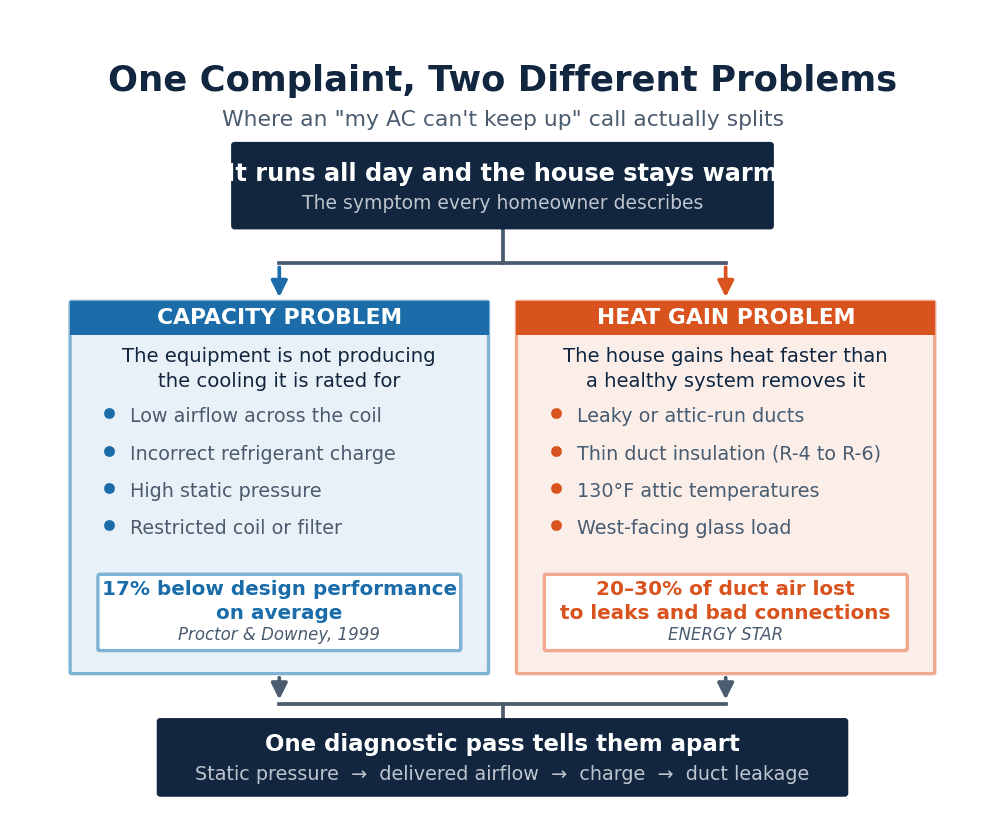
This is the version that usually does point to a fault. When the unit runs nonstop and can’t hit your setpoint at moderate outdoor temps, something is restricting cooling. Here’s what we find most often, ranked by how frequently it shows up on our service calls.

Dirty or clogged air filter (the most common true airflow culprit)

This is the one homeowners can fix themselves, and it’s the cause we catch most. A clogged filter chokes airflow. According to Carrier, it can even freeze the evaporator coil, which leaves the system running but blowing weak or warm air.

The U.S. Department of Energy reports that swapping a dirty filter for a clean one can cut energy use by 5 to 15%. DOE recommends checking or replacing it every 1 to 2 months during cooling season, and more often if you have pets, heavy dust, or run the AC constantly. ENERGY STAR suggests a monthly look.

Dirty condenser or evaporator coils

Coils collect grime over time, even behind a clean filter. The DOE notes a dirty condenser coil can raise compressor energy use by 20 to 30%. A clogged evaporator coil can cut cooling capacity by 20 to 40%, per DOE-cited maintenance data, so the system runs full-time and still can’t reach the temperature you set.

You can help the outdoor unit by keeping about 2 feet of clearance around it and trimming back foliage. The evaporator coil sits indoors and is a tech job.

Low refrigerant, which actually means a leak

Here’s a fact that surprises a lot of people: refrigerant doesn’t get used up. It runs in a sealed loop. So if your system is low, there’s a leak somewhere.

A charge of just 10% low cuts efficiency by about 20%, according to DOE-cited figures, which forces longer runtimes. By law, only an EPA Section 608-certified technician can handle refrigerant, so this is a clean stop-and-call-a-pro situation. More on the cost angle below.

Leaky or poorly sealed ductwork

ENERGY STAR estimates homes lose roughly 20 to 30% of conditioned air through duct leaks. That cooled air escapes into attics and wall cavities and never reaches your rooms, so the system keeps chasing a target it can’t catch. Finding and sealing leaks is a tech job.

An undersized system

If the unit is genuinely too small for the home, it runs constantly because it can’t meet the load. Per UGI and Coolray, chronic low pressure can even freeze the coil and send liquid refrigerant back to the compressor, which is an expensive failure.

The fix isn’t a same-size swap. It needs a Manual J load calculation, the ACCA-standard method that sizes equipment to your actual home: square footage, windows, insulation, and climate. Worth noting for accuracy: an oversized unit does the opposite and short-cycles (turns on and off too often) without dehumidifying well. So “runs constantly” points toward undersizing, airflow, or low charge, not oversizing.

An aging system

Properly maintained central AC typically lasts 15 to 20 years, according to Trane and Carrier. Neglected units can fail closer to 10. Efficiency fades with age, so a unit past the 10-to-15-year mark that runs nonstop and needs repeated repairs becomes the classic replacement candidate.

An electrical fault

A weak or failing run capacitor is widely cited as a leading cause of summer AC breakdowns. The motor struggles, behavior turns erratic, and runtime suffers. Capacitors and electrical connections get checked during a standard tune-up.

This one sits right where our trades overlap. The same crew that diagnoses your AC can handle the electrical side, so if a capacitor or wiring issue turns up, our licensed electrical team can take it from there in the same visit.

Which AC Problems Can I Check for Myself, and Which Need a Tech?

A quick side-by-side so you know where the line is.

Cause Can you check it yourself? Typical fix
Extreme heat + 20° limit Yes, run The Quality 20° Check Often nothing; system is working
Dirty air filter Yes Replace filter (every 1 to 2 months)
Outdoor coil debris/clearance Partly (clear 2 ft. around unit) Pro cleaning for deep buildup
Evaporator coil No Professional cleaning
Low refrigerant / leak No (Section 608 by law) Certified tech leak repair + recharge
Duct leaks No Professional duct sealing
Undersized unit No Manual J load calc, correct sizing
Aging system Partly (check the install date) Repair vs. replace assessment
Run capacitor / electrical No Tech diagnosis during tune-up

If you’ve checked the filter, the outdoor clearance, and the 20° math and the house still won’t cool, that’s your cue to book a visit. Quality Heating, Cooling, Plumbing & Electric can run the full diagnosis across the Tulsa area, including Broken Arrow, Owasso, Bixby, Jenks, and Sand Springs.

Does Low Refrigerant Cause an AC to Run Constantly, and is R-410A Still Legal?

Yes, low refrigerant forces longer runtimes. And there’s a 2025 to 2026 rule change worth understanding, because it affects the cost of recharging older systems.

Under the AIM Act of 2020, the EPA is phasing down high-GWP HFC refrigerants. The Technology Transitions Rule, finalized in October 2023, requires new residential AC and heat-pump equipment to use refrigerant with a Global Warming Potential under 700. As of January 1, 2025, manufacturers stopped making new residential systems that use R-410A (GWP 2,088) as the primary refrigerant, according to NAHB and AC Direct reporting. The replacements are R-454B (GWP 466) and R-32 (GWP 675), both classed A2L (mildly flammable).

Here’s the reassuring part: R-410A is not banned. Existing systems can be legally serviced, repaired, and recharged for the foreseeable future, per Trane and NAHB. A fresh EPA final rule even allows continued installation of pre-2025 R-410A units until supplies deplete, effective July 27, 2026. Rules vary by state, though, and Oklahoma has no equivalent statewide install ban noted, so confirm specifics locally.

What you can act on: R-410A wholesale prices have climbed materially as the HFC cap tightens, with trade sources reporting figures in the range of 40 to 70% above 2022 levels (AC Direct). So a recurring “low refrigerant” recharge on an older R-410A system is getting pricier over time. That’s now a legitimate input into the repair-versus-replace decision. For your actual numbers, request a quote from a licensed tech rather than relying on a published figure, since prices move.

When Should I Call an HVAC Tech for an AC That Runs All the Time?

Stop troubleshooting and book a service call if you notice any of these field markers. These are the boundaries our techs treat as “call now,” because crossing them with DIY usually makes things worse.

  • Warm or room-temperature air from the vents while the system runs nonstop.
  • Ice or frost on the refrigerant lines or indoor coil. This points to restricted airflow or a leak, and running it frozen risks compressor damage.
  • A sudden, unexplained jump in your electric bill at similar outdoor temps. HVAC Base flags a jump above 15% as a developing fault.
  • The system never reaches your setpoint, even overnight when it’s mild out.
  • Buzzing or grinding noises, or the unit cutting out mid-cycle. Possible capacitor or electrical issue.
  • The temperature difference between return and supply air falls outside the healthy 15 to 22°F range (delta-T).

Anything involving refrigerant, the sealed system, electrical parts, or a sizing question is a licensed-pro job. Refrigerant is restricted by law, and the rest because one wrong move, like running a frozen system, can turn a small fix into a compressor-level repair. ENERGY STAR sums up the root of most of these calls in one line: “Dirt and neglect are the top causes of heating and cooling system failure and inefficiency.”

If you’re seeing any of those signs, our team is ready to help. Quality Heating, Cooling, Plumbing & Electric serves Tulsa, Broken Arrow, Claremore, Sapulpa, Muskogee, Wagoner, and the surrounding communities. Call us to get it diagnosed before a small issue becomes a big one.

Should I Repair or Replace an AC That Runs Constantly?

It depends mostly on age and repair history. A unit under 10 years old with a fixable fault (filter, capacitor, coil, single leak) is usually worth repairing. A unit past 15 years that runs nonstop, needs repeated visits, and is burning through increasingly expensive R-410A recharges, leans toward replacement.

There’s no universal answer here, and we won’t pretend there is. The honest call comes from a tech looking at your specific system, your runtime, and your energy bills. A proper assessment also includes a Manual J check if sizing is in question, so a replacement is sized to your home instead of just matching the old box.

Frequently Asked Questions

Why won’t my air conditioner turn off? On hot days, near-continuous running is often normal because of the 20°F design limit. If it runs nonstop and can’t reach your setpoint when it’s only moderately warm out, suspect a dirty filter, low refrigerant, duct leaks, or a coil issue, and have it checked.

Can an air conditioner only cool 20 degrees below outside? Roughly, yes, though the exact figure varies with your home’s insulation, air sealing, and heat loads. Standard residential systems are built to pull indoor air to about 20°F below the outdoor temperature. On a 100°F day, indoor temps near 80°F with constant runtime are expected, not a malfunction. 

How often should I change my AC filter in summer? The DOE recommends checking or replacing it every 1 to 2 months during cooling season, and more often with pets, heavy dust, or constant use. A clean filter alone can cut energy use 5 to 15%.

Does a dirty filter really make my AC run longer? Yes. A clogged filter restricts airflow, drops cooling output, and can freeze the evaporator coil, leaving the system running while it struggles to cool. It’s the most common DIY-fixable cause we find.

My AC is running constantly and my electric bill spiked. What’s wrong? A bill jump above 15% at similar outdoor temps usually signals a developing fault: low refrigerant, a dirty coil, a weak capacitor, or duct loss. It’s worth a professional diagnosis rather than waiting it out.

How long do central AC units last in Oklahoma? With regular maintenance, 15 to 20 years is typical (Trane, Carrier). Neglected units can fail closer to 10. Our hot Tulsa summers put real hours on these systems, so consistent upkeep matters.

Get a Straight Answer on Your AC, Not a Guess

If your AC is running nonstop and you’ve already run The Quality 20° Check, swapped the filter, and cleared the outdoor unit, the next step is a real diagnosis. Quality Heating, Cooling, Plumbing & Electric handles AC, plumbing, and electrical repair, installation, and maintenance across the Tulsa metro, from Bartlesville and Owasso to Bixby, Jenks, and Sapulpa. 

Reach out and we’ll find out what’s actually going on, then give you honest options for fixing it.

What Causes High Humidity in a House (And How to Fix It)

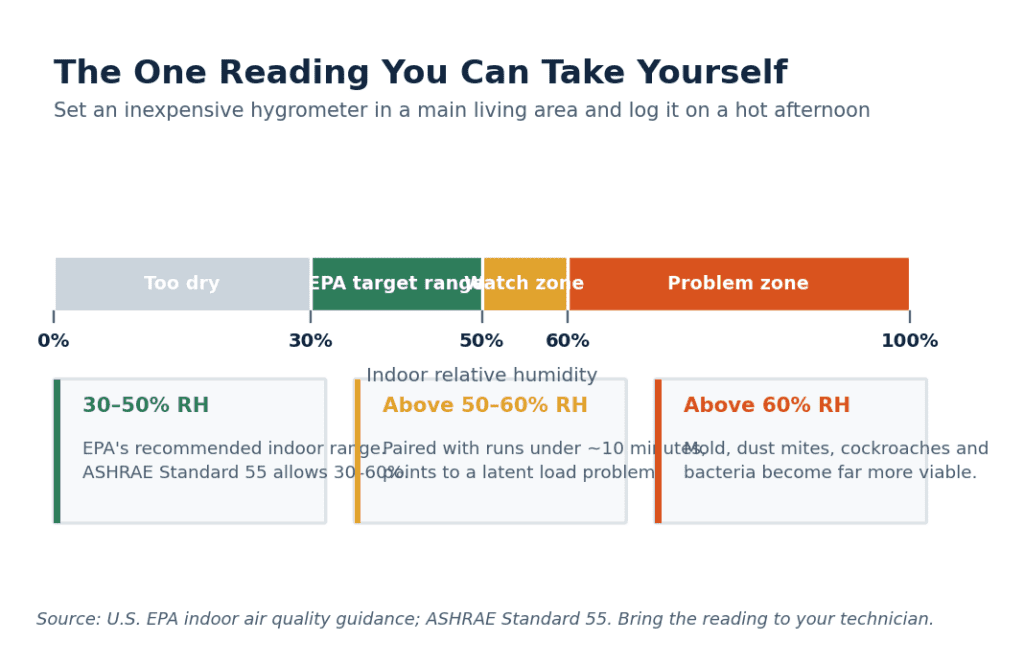
Quick answer: High humidity in a house usually comes from one of five things: an oversized AC that shuts off too fast, leaky ducts, hidden plumbing or crawl space leaks, weak exhaust ventilation, or a thermostat fan left on “ON” instead of “AUTO.” The EPA recommends keeping indoor humidity between 30% and 50%, and below 60%, to keep mold and dust mites in check. The good news? Most of these causes are fixable once you know what to look for.

Ever walk into your own home and feel that sticky, heavy air, even though the AC is running? You’re not imagining it. A cool house can still be a clammy one, and that combination usually points to a moisture problem, not a temperature problem.

Here in the Tulsa area, this comes up a lot. We’ve helped many homeowners across Broken Arrow, Owasso, Sapulpa, and Bixby figure out why their indoor air feels swampy even with the thermostat set low. If you’ve been chasing that muggy feeling without answers, our team at Quality Heating, Cooling, Plumbing & Electric handles this often, and you can reach out for HVAC service in Tulsa, OK whenever you want a real diagnosis instead of a guess.

Below, we’ll walk through what actually drives indoor humidity, how to spot each cause, and what you can do about it. Some of these you can check yourself today. Others need a trained set of eyes.

Why Indoor Humidity Matters More Than Most People Think

Before we get into causes, here’s why this is worth your attention.

Damp air doesn’t just feel uncomfortable. It creates the conditions mold needs to grow. According to the EPA, mold can start growing on wet surfaces within 24 to 48 hours, which is why wet spots should be dried fast. The EPA also notes that mold can produce allergens and irritants, and some exposure has been linked to symptoms like nasal irritation, headaches, and fatigue.

One useful note for peace of mind: the CDC does not recommend mold testing for most homes, because health effects vary so much from person to person. The smarter move is controlling the moisture in the first place.

So keeping humidity in that 30% to 50% range isn’t about being picky. It’s about protecting your home and the people in it.

A quick local reality check: Tulsa sits in a humid subtropical climate, with average annual relative humidity around 66%, climbing toward 70% in September. Summer dew points here regularly pass 65°F, the point where air starts to feel noticeably muggy. That means homes across our whole service area are fighting outdoor conditions that constantly push indoor humidity above the EPA’s target. You’re not doing anything wrong. The weather is working against you.

The 5-Point Humidity Diagnostic: How We Track Down the Real Cause

When we get a humidity call, we don’t guess. We work through five common culprits in order. Think of it as a 5-Point Humidity Diagnostic: Sizing, Ducts, Drainage and Plumbing, Ventilation, and Settings. Let’s go through each one.

1. Your AC Is Oversized and Short-Cycling (the most common surprise)

This is the big one, and it catches a lot of people off guard.

Your air conditioner only pulls moisture out of the air while the compressor is actually running. An oversized unit cools your home to the thermostat setting too quickly, then shuts off before it has had time to dry the air out. The result is a house that feels cool but clammy.

HVAC sources widely describe short cycling as the leading reason an AC “cools but doesn’t dehumidify.”

Here’s a simple test you can run today: Watch your system for an hour.

  • If it turns on and off more than 3 to 4 times an hour, that’s a red flag.
  • If individual cooling cycles run under about 10 minutes, that’s another.

Short, frequent cycles mean your AC isn’t running long enough to do its second job: removing water from the air.

2. The Professional Fix Has a Name: Manual J

Here’s something DIY advice rarely tells you. You can’t fix an oversized system by just turning it down.

Both the Air Conditioning Contractors of America (ACCA) and the U.S. Department of Energy recommend a Manual J load calculation to size equipment correctly, instead of guessing by square footage. ENERGY STAR-qualified homes size both the equipment and the ducts using ACCA Manual J and Manual D.

In plain terms, this is a math-based process that figures out exactly how much cooling your specific home needs, based on its layout, windows, insulation, and more. When we size a replacement system this way, the unit runs longer, gentler cycles that actually wring the moisture out.

3. Leaky or Poorly Designed Ductwork

Even a perfectly sized AC can’t win if your ducts are leaking.

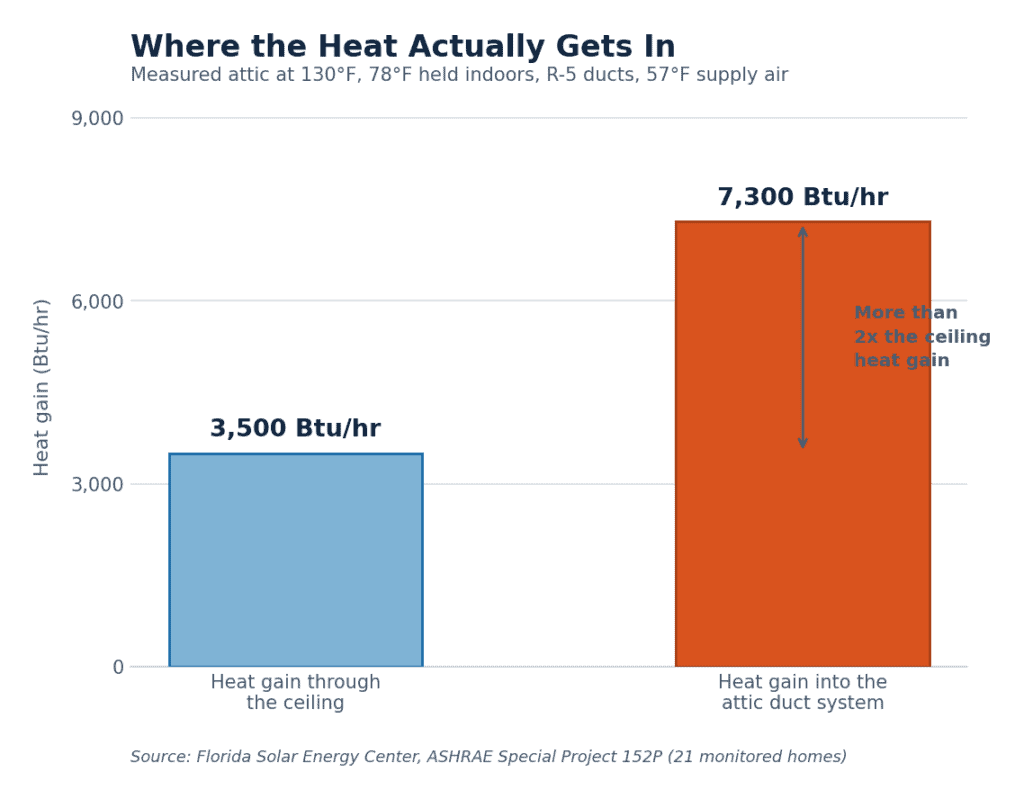
Per ENERGY STAR and the DOE, about 20% to 30% of the air moving through a typical duct system gets lost to leaks and bad connections. Worse, ducts that run through hot, unconditioned attics or damp crawl spaces can pull humid outside air right into your system. The NREL estimates ducts in those spaces can lose 25% to 40% of conditioned energy.

So you’re paying to cool air that escapes, while muggy air sneaks in. Sealing and properly routing ductwork keeps the dry, conditioned air where it belongs.

Want a faster way to think about which problem you have? Here’s a side-by-side look:

What You Notice Likely Cause Who Can Fix It
House cools fast but feels clammy Oversized AC, short cycling HVAC pro (Manual J resize)
Some rooms muggy, high energy bills Leaky or attic-run ducts HVAC pro (duct sealing)
Musty smell, soft floors, water bill jump Hidden plumbing or crawl space leak Licensed plumber
Steamy bathroom or kitchen lingers Weak or wrongly vented exhaust fans HVAC or handyman fix
Cool air but humid right after AC stops Fan set to “ON” not “AUTO” You, in 10 seconds

If your symptoms point toward that third row, the moisture problem may not be in your air system at all. It may be under your feet. When that’s the case, a plumbing inspection is the right next step, and our team handles hidden leak detection and plumbing repair across the Tulsa metro.

4. Hidden Plumbing Leaks and Crawl Space Moisture

This one hides in plain sight.

A slow leak under your home can saturate soil, insulation, and framing. That trapped moisture rises into your living space, since warm air carries more water vapor. You may never see a drip, but you’ll feel the dampness.

Early warning signs to watch for:

  • A musty smell that won’t go away
  • Sudden, unexplained humidity spikes
  • Soft, loose, or springy spots in the flooring
  • A jump in your water bill you can’t explain

If two or more of these line up, it’s worth having someone check the crawl space and supply lines before mold gets a foothold.

5. Inadequate Exhaust Ventilation

Sometimes the fix is as simple as where your fans send the air.

The EPA and CDC both advise using kitchen and bathroom exhaust fans that vent outside the home, and making sure your clothes dryer vents outside too. A surprisingly common defect is a fan that dumps all that moist air straight into the attic, where it just sits and spreads.

So run those fans during and after showers and cooking, and confirm they actually push air outdoors, not into your ceiling.

6. The “ON” vs. “AUTO” Fan Setting (the free fix almost nobody mentions)

Save this one. It costs nothing and takes ten seconds.

When your thermostat fan is set to “ON,” the blower runs nonstop. The problem? Moisture that condensed on your cold AC coil gets re-evaporated and blown back into your house before it can drain away. As building-science source Energy Vanguard frames it, a continuously running indoor fan can basically act like a humidifier once the compressor shuts off.

Switching the fan to “AUTO” lets the coil drain between cycles, so that water leaves your home instead of recirculating.

One related cause to check: a clogged AC condensate drain line can also back moisture up instead of carrying it away. If you see standing water near your indoor unit, that line may need clearing.

A Quick Note If You’re Already Replacing Your AC

This isn’t a humidity cause, but it’s worth knowing if a resize is on the table.

As of January 1, 2025, new residential AC and heat pump equipment must use low-GWP A2L refrigerants (R-454B or R-32) instead of R-410A, under the EPA’s AIM Act phase-down. Here’s the part that matters for your wallet: existing R-410A systems can keep running. There’s no mandate to replace them, and service and parts remain available. So this only comes into play if you’re already buying new equipment.

What About Winter Humidity?

Most humidity problems peak in summer, but winter dampness happens too, usually from daily living: cooking, showering, drying clothes indoors, and tight, well-sealed homes that trap moisture. The same exhaust-ventilation tips above apply year-round. If winter humidity stays stubbornly high, it can point to ventilation gaps worth having checked.

Get a Straight Answer About Your Home’s Humidity

You don’t have to live with sticky air or keep guessing at the cause. Run the simple checks first: watch your AC’s cycle time, switch the fan to AUTO, and confirm your exhaust fans vent outside. If the dampness sticks around, that usually means the issue is in your system sizing, your ducts, or your plumbing, and those need a trained diagnosis.

We’ve helped homeowners all over Tulsa, Broken Arrow, Owasso, Jenks, Sapulpa, and the surrounding towns get to the bottom of moisture problems. If you’d like a real set of eyes on yours, the team at Quality Heating, Cooling, Plumbing & Electric is ready to help you find the cause and fix it the right way. Reach out whenever you’re ready for an honest assessment.

Frequently Asked Questions

Why is my house so humid even with the AC on? Usually because the AC isn’t running long enough to dehumidify. An oversized unit cools fast and shuts off before it removes moisture. Leaky ducts and a fan stuck on “ON” can make it worse. Check your cycle length and fan setting first.

Can an oversized air conditioner cause high humidity? Yes. An oversized AC reaches the temperature setting too quickly, then shuts off before it has time to pull water out of the air. You end up cool but clammy. The proper fix is sizing the system with a Manual J load calculation.

Should my thermostat fan be on AUTO or ON for humidity? For lower humidity, use AUTO. On “ON,” the blower runs constantly and can re-evaporate moisture off the coil back into your home. AUTO lets that water drain away between cooling cycles.

What humidity level causes mold in a house? The EPA recommends staying between 30% and 50%, and below 60%. Mold risk climbs as you pass 60%, and mold can begin growing on damp surfaces within 24 to 48 hours.

Is 60% humidity too high in a house? It’s at the upper edge. The EPA advises keeping indoor humidity below 60% to limit mold, dust mites, and allergens. Aiming for 30% to 50% gives you more comfort margin.

How do I know if I have a hidden plumbing leak? Watch for a musty smell, soft or springy flooring, unexplained humidity spikes, and a water bill that jumps for no clear reason. If a few of these show up together, have a plumber inspect your lines and crawl space.

How long does it take for mold to grow from humidity? Per the EPA, mold can start growing on wet surfaces within 24 to 48 hours, which is why damp areas should be dried quickly.

Note: This article shares general guidance based on EPA, CDC, DOE, and ENERGY STAR recommendations. Every home is different, so for an accurate diagnosis and quote, it’s best to have a licensed professional inspect your specific system.

High Energy Bills After HVAC Tune Up? Here’s Why

You just paid for a HVAC tune-up. Your system is running. Everything seems fine. But when the next utility bill arrives, the number hasn’t budged.

Sound familiar? You’re not alone. At Quality Heating, Cooling, Plumbing & Electric, we hear this story often from homeowners across Tulsa and the surrounding areas. The frustration is real. You did the right thing by scheduling maintenance, so why are you still paying through the nose for heating and cooling?

Here’s what’s actually happening: standard tune-ups handle the basics, but they don’t catch the hidden energy drains lurking in your home. The good news? Once you understand what’s really driving those costs, you can take action to fix it.

Let’s look at the real culprits behind stubbornly high energy bills, even after your system gets serviced.

Your Ductwork Might Be Leaking

Think of your ductwork as a highway for heated or cooled air. Now imagine that highway has massive potholes everywhere, letting all that conditioned air escape before it reaches your living spaces.

That’s exactly what happens with leaky ducts.

ENERGY STAR reports that 20-30% of air moving through duct systems gets lost due to leaks, holes, and poor connections. That’s nearly a third of the air you’re paying to heat or cool, vanishing into attics, crawl spaces, or wall cavities.

What Actually Causes Duct Leaks?

  • Poorly sealed connections at joints and registers
  • Aging duct tape or mastic that’s dried and cracked
  • Punctures from pests or construction work
  • Disconnected sections that came loose over time

If your ducts run through unconditioned spaces, every leak works against your efficiency. 

Your Home’s Insulation Is Probably Inadequate

Your HVAC system can be in perfect condition, but if your home can’t hold the temperature, you’re fighting a losing battle.

Here’s a sobering fact: a recent analysis using 2024 data found that 89% of U.S. single-family homes are under-insulated compared to modern energy codes. That means almost nine out of ten homes force their heating and cooling systems to work overtime just to maintain comfort.

The EPA estimates that properly sealing and insulating can reduce heating and cooling costs by an average of 15%. But a tune-up doesn’t include an insulation assessment. Your technician focuses on the equipment itself, not the building envelope that determines how hard that equipment has to work.

Where Insulation Problems Hide

Common trouble spots include:

  • Attic spaces where heat rises and escapes in winter or radiates down in summer
  • Basement or crawl space walls that let cold air seep into your home
  • Wall cavities in older homes built before modern efficiency standards
  • Areas around pipes and wiring where insulation was never installed properly

Even if you had insulation installed years ago, it can settle, get compressed, or absorb moisture over time. This reduces its effectiveness, but you won’t see any visual signs of the problem from inside your home.

Your System Might Be the Wrong Size

This one surprises people. How can a system that’s “too big” be a problem?

Oversized HVAC systems short-cycle, turning on and off frequently instead of running steady cycles. This wastes energy in several ways. First, the system uses extra power during each startup. Second, it never runs long enough to properly dehumidify the air in cooling mode. Third, constant cycling wears out components faster.

Studies show that oversized systems can undermine efficiency gains, with penalties increasing in higher-SEER units due to latent heat issues. Essentially, you paid for a high-efficiency system, but improper sizing prevents it from delivering the promised savings.

Undersized systems have the opposite problem. They run constantly, trying to reach a temperature they can never quite achieve. Either way, you’re paying more than you should.

Why Sizing Problems Happen

A proper HVAC installation requires a Manual J load calculation, which factors in:

  • Square footage and ceiling heights
  • Window size, placement, and quality
  • Insulation levels throughout the home
  • Local climate conditions
  • Number of occupants and heat-generating appliances

Many older systems were sized using rough estimates or the “bigger is better” approach. Standard tune-ups check if your existing system operates correctly, but they don’t verify if you have the right system in the first place.

Your Thermostat Could Be Lying to You

You set the thermostat to 72°F, but the actual temperature in your home might be 68°F or 76°F. This calibration drift happens over time, especially with older thermostats.

Common calibration drift can result in temperature discrepancies of 4-5°F, causing your system to run far longer than necessary. If your thermostat thinks it’s 68°F when it’s actually 72°F, your heating system keeps running and running, burning energy to chase a target that’s already been met.

Placement makes this worse. We’ve seen thermostats installed:

  • In direct sunlight from a nearby window
  • Next to exterior doors where drafts hit constantly
  • On walls backing up to uninsulated spaces
  • Near heat-generating appliances or lamps

Any of these locations gives false readings that trigger unnecessary system operation. A tune-up might verify the thermostat turns the system on and off, but precise recalibration or relocation recommendations often get missed.

Your Air Filter Isn’t Lasting as Long as You Think

Yes, the technician changed your filter during the tune-up. But what happens in the months between services?

Restricted airflow from degraded filters forces the system to work harder, potentially increasing energy consumption by 5-15%. How quickly your filter clogs depends on several factors that vary by household:

  • Pets that shed fur and dander
  • Local pollen and dust levels
  • How often you run the system
  • Whether you have smokers in the home
  • Recent construction or remodeling projects

We’ve helped many homeowners who assumed a filter change during their annual tune-up was sufficient. Six months later, the filter is so clogged that the system struggles to pull air through it. The blower motor works overtime, using more electricity to move less air.

The Filter Quality Factor

Not all filters are created equal. Higher MERV-rated filters capture more particles, but they can also restrict airflow if not properly matched to your system. The right filter balances air quality and system performance, but this requires professional guidance based on your specific equipment and home conditions.

Between professional visits, checking and changing filters every 1-3 months typically works better than waiting for the next tune-up. For homes with the factors mentioned above, monthly checks make sense.

Low Refrigerant Is Stealing Your Efficiency

Your air conditioner or heat pump depends on proper refrigerant levels to transfer heat effectively. When the charge is low, the system can’t move heat efficiently, so the compressor runs longer and harder trying to compensate.

Faults like undercharge can contribute to 15-30% energy waste in affected systems. That’s a massive penalty hiding in your system, invisible without proper testing equipment.

Basic tune-ups may check refrigerant pressure, but small leaks can go undetected. A system might have adequate charge during the spring tune-up, but a slow leak drops levels by mid-summer when you need cooling most.

The 2026 Refrigerant Rule Changes

There’s an added complexity now. As of 2026, EPA regulations under the AIM Act restrict high-GWP refrigerants in new installations and certain repairs. If you have an older system with a refrigerant leak, the fix might involve more than just topping off the charge.

We coordinate with the latest EPA regulations to help ensure your system stays compliant and efficient. If refrigerant issues are suspected, consult your service provider for a complete assessment rather than assuming a simple recharge will solve the problem.

What a Standard Tune-Up Actually Covers

Understanding what’s included in typical maintenance helps explain why bills stay high even after service.

Most tune-ups focus on:

  • Cleaning condenser and evaporator coils
  • Checking electrical connections and voltage
  • Replacing the air filter
  • Verifying basic system operation

These steps improve short-term operation and prevent breakdowns, which is valuable. But they don’t address structural issues like duct leaks, insulation gaps, or sizing problems. Those require different diagnostic tools and approaches.

At Quality Heating, Cooling, Plumbing & Electric, we’ve got vast experience helping homeowners understand the difference between maintenance and comprehensive energy assessments. Both have their place, but they serve different purposes.

When to Consider a Deeper Energy Assessment

If your bills remain high despite regular maintenance, it’s usually time for a more thorough evaluation. A comprehensive assessment might include:

  • Infrared camera scans to reveal insulation gaps and air leaks
  • Manual J load calculations to verify proper system sizing
  • Refrigerant charge testing with precise gauges and superheat/subcooling measurements
  • Thermostat calibration and placement review

These diagnostics require specialized equipment and training. The investment can pay off quickly when the results reveal fixable problems that have been driving costs up for years.

The Hidden Cost of Multiple Small Problems

Here’s what makes high energy bills particularly stubborn: these issues compound each other.

Leaky ducts combined with poor insulation means your system works harder to overcome both problems. Add an oversized system that short-cycles, and you’re wasting energy in three different ways simultaneously. Throw in a miscalibrated thermostat, and the problem gets even worse.

Each individual issue might account for 10-20% waste on its own. Together, they can double your energy consumption compared to a properly functioning, well-designed system in a tight, well-insulated home.

This explains why some homeowners see minimal savings after a tune-up. The maintenance addressed one small piece of a much larger puzzle.

Making Better Decisions About Your HVAC Investment

You don’t need to tackle everything at once. But understanding what’s really driving your costs helps you prioritize improvements that deliver actual savings.

Start with a professional energy assessment if bills concern you. The findings will show which problems have the biggest impact in your specific home. From there, you can make informed decisions about:

  • Whether duct sealing would provide significant returns
  • If insulation upgrades should be your first priority
  • Whether your system is incorrectly sized and due for replacement anyway
  • What thermostat improvements might help
  • How often your specific home needs filter changes

With proper preparation and the right information, you can move toward lower energy bills with confidence. We work to ensure homeowners in Tulsa, Broken Arrow, Owasso, Jenks, Bixby, and throughout the surrounding areas have access to accurate information about their home comfort systems.

Ready to Find Your Real Energy Drains?

Energy bills don’t have to stay high forever. The key is identifying what’s actually wrong, not just assuming a tune-up will fix everything.

If you’ve had recent maintenance but haven’t seen the savings you expected, Quality Heating, Cooling, Plumbing & Electric uses professional diagnostic equipment to find the specific issues affecting your home’s efficiency.

Our team serves Bartlesville, Claremore, Sand Springs, Sapulpa, Muskogee, and communities throughout the Tulsa area. With many years of experience in heating, air conditioning, plumbing, and electrical work, we’ve helped thousands of homeowners understand what’s really happening with their systems.

Actions speak louder than words. That’s why we focus on finding real solutions instead of offering generic advice. Contact Quality Heating, Cooling, Plumbing & Electric to schedule an energy assessment and discover what’s keeping your bills high.

Frequently Asked Questions

Can I check my home’s insulation myself?

You can do a basic visual check in accessible areas like attics, but a professional assessment with tools like infrared cameras reveals hidden problems in walls and other spaces. The 89% under-insulation rate shows how common this issue is, but proper evaluation requires measuring R-values and identifying gaps that aren’t visible to the naked eye.

How do I know if my HVAC system is the wrong size?

Watch for signs like short-cycling (frequent on-off operation), uneven temperatures between rooms, high humidity during cooling season, or the system constantly running without reaching the set temperature. Accurate sizing requires a Manual J load calculation by a qualified professional who can factor in your home’s specific characteristics.

Will a smart thermostat solve calibration problems?

Smart thermostats generally have better accuracy than older models, but placement still matters. If your thermostat sits in direct sunlight or near a draft, even smart technology will get false readings. Upgrading can help, but proper placement is equally important for accurate temperature control.

How often should I really change my air filter?

It varies based on your home conditions. Homes with pets, high dust levels, or constant system use need monthly filter checks. Homes without these factors might change filters every 2-3 months. The 5-15% efficiency penalty from clogged filters adds up quickly, so checking more often costs less than the energy waste from a restricted filter.

What’s the current situation with refrigerant regulations?

The EPA’s AIM Act restricts certain high-GWP refrigerants starting in 2026 for new installations and some repair situations. If your system has a refrigerant leak, consult a professional about compliant options. Older systems may have grace periods, but ongoing leaks cause the 15-30% efficiency loss regardless of regulatory status, so addressing leaks makes sense from both a cost and compliance standpoint.

How Often Should You Schedule HVAC Maintenance for Maximum Home Comfort?

How Often Should You Schedule HVAC Maintenance for Maximum Home Comfort?

Your home’s heating and cooling system works around the clock to keep your family comfortable. But when was the last time you gave it the professional attention it deserves?

Here’s what we see daily: Homeowners call us in panic when their AC fails during a scorching summer day or their heater quits on the coldest night of winter. These emergency situations could often be prevented with proper maintenance scheduling. But, if these are not prevented then you would eventually need AC repair service in Owasso, OK.

At Quality Heating, Cooling, Plumbing & Electric, we’ve helped many families maintain their systems. Through our plumbing company in Tulsa, OK experience, we’ve learned that twice-yearly professional maintenance is essential for every HVAC system, regardless of age. This schedule saves you money, prevents breakdowns, and keeps your home comfortable year-round.

The Professional Standard: Why Twice Yearly Is Non-Negotiable

We recommend professional HVAC maintenance twice per year for every system – once in spring for your cooling system and once in fall for your heating components. This isn’t just industry best practice; it’s what your system needs to perform reliably.

This biannual approach aligns with seasonal demands and helps catch issues before they become expensive problems, whether your system is brand new or has been serving your family for decades.

When we service systems that follow this schedule, we consistently see:

  • Fewer emergency repair calls
  • Lower energy bills
  • Systems that last years longer than those with less frequent service
  • Optimal performance regardless of system age

For quality hvac service in Tulsa and throughout the USA, this twice-yearly timing works perfectly because it prepares your system for peak usage periods.

What Influences Your Maintenance Schedule?

While we recommend biannual maintenance for all systems, certain conditions may require additional professional attention:

Environmental Challenges

  • High dust areas: If you live in a dusty region or near construction, your system works harder to filter air
  • Extreme climates: Homes in very hot or cold regions put additional strain on their systems
  • High humidity: Coastal areas or humid climates create extra challenges for cooling systems

Heavy Usage Patterns Homes with constant system use, large families, or pets may benefit from quarterly filter changes and additional check-ups between our standard biannual services.

System-Specific Considerations Even newer systems with smart technology need our full twice-yearly service to maintain warranty compliance and optimal performance. Older systems already receive the attention they need with our standard biannual approach.

New 2025 Regulations That Affect Your Maintenance

Starting January 1, 2025, the EPA implemented new refrigerant regulations that directly impact how we maintain cooling systems. New residential air conditioners and heat pumps must use lower global warming potential refrigerants like A2L types (R-454B or R-32), replacing R-410A in newly manufactured systems.

What this means for your maintenance schedule:

  • Systems installed after January 2025 may require specialized handling during service
  • If you’re planning a system replacement, maintenance becomes even more critical to maximize your current system’s life
  • Professional technicians now need specific training for these new refrigerants

If you have an older system, you can continue repairs in Broken Arrow, OK with existing refrigerants, but professional maintenance helps ensure compliance during any major work.

The Real Benefits of Consistent Maintenance

Energy savings alone often justify the maintenance cost. According to Energy.gov, well-maintained systems can reduce energy usage by up to 20%. For the average American household spending $2,000+ annually on energy, that’s potentially $400 in savings.

But the benefits go deeper:

Improved Air Quality

Regular maintenance includes cleaning components that directly affect your indoor air quality. Clean filters and coils mean cleaner air for your family.

Fewer Emergency Repairs

As our professionals note: “Regular HVAC maintenance is a smart investment in longevity, energy efficiency, and reliability.” We see this proven repeatedly with our maintenance customers experiencing far fewer emergency calls.

Extended Equipment Life

Think of it like car maintenance. As one of our technicians explains: “Just as you would not drive your car without ever changing the oil, you should not be constantly operating your HVAC system without maintenance.”

Smart Technology Is Changing Maintenance Scheduling

The future of maintenance is becoming predictive rather than reactive. Smart HVAC systems with IoT integration can now alert both homeowners and professionals to potential issues before they cause problems.

These systems might indicate when maintenance is needed based on:

  • Actual runtime hours
  • Performance efficiency changes
  • Filter condition sensors
  • Component wear indicators

While this technology is promising, it doesn’t replace professional maintenance but rather helps optimize timing.

Commercial vs. Residential: Why Business Standards Matter

Commercial buildings typically follow biannual maintenance schedules because downtime costs businesses money. We apply similar thinking to residential service because your family’s comfort matters just as much.

For businesses, standard practice includes:

  • Spring preparation for cooling season
  • Fall preparation for heating season
  • More frequent filter changes
  • Detailed documentation for warranty purposes

How to Choose Your Maintenance Schedule

Our Standard Service Schedule: Every system receives biannual maintenance:

  • Spring Service: Comprehensive cooling system preparation
  • Fall Service: Complete heating system inspection and tune-up

Enhanced Service Options: Consider quarterly visits if:

  • You have health concerns requiring excellent air quality
  • Your system operates in challenging conditions (dusty, humid, extreme temperatures)
  • You run a home business depending on consistent climate control
  • You prefer maximum system optimization

Why We Don’t Recommend Annual-Only Service: While some companies offer annual maintenance, our experience shows that systems serviced only once per year experience more breakdowns, higher energy costs, and shorter lifespans. Your investment in biannual care pays for itself through reliability and efficiency.

Ready to Protect Your Home’s Comfort?

Ready to give your system the professional care it deserves? Don’t wait for an emergency to think about maintenance.

At Quality Heating, Cooling, Plumbing & Electric, our biannual maintenance program has helped many families avoid costly breakdowns while enjoying lower energy bills and superior home comfort.

Schedule your next maintenance visit today and join our customers who trust us for reliable, twice-yearly system care. Your family’s comfort is worth the professional standard.

Frequently Asked Questions

Q: Why do you recommend twice-yearly maintenance for all systems when some companies suggest annual service is enough for newer systems? A: Our experience servicing numerous systems shows that all HVAC equipment benefits from biannual attention, regardless of age. Seasonal demands, indoor air quality factors, and component wear occur in both new and older systems. Annual service simply isn’t frequent enough to catch issues before they become problems.

Q: Is twice-yearly maintenance really cost-effective for a newer system? A: Absolutely. Even new systems accumulate dust, experience normal wear, and need seasonal adjustments. The energy savings from biannual maintenance (up to 20% reduction in usage) typically offset the service cost, while preventing warranty issues and extending system life from day one.

Q: What’s included in your biannual maintenance that makes it different from annual service? A: Our spring and fall services address different seasonal needs. Spring service focuses on cooling components, refrigerant levels, and preparation for summer demands. Fall service emphasizes heating elements, ventilation, and winter readiness. This targeted approach catches issues that annual service might miss.


Ten Tips to Lower Your Electric Bill in Claremore, Oklahoma

Oklahoma’s blazing summers and often freezing winters lead to some sizable swings in our monthly electric bills. Quality Heating, Cooling, Plumbing & Electric is the local leader in expert electrical services in Claremore, Oklahoma, and we’d like to share some simple energy-saving tips to lower electric bills.

1. Install and Program a Smart Thermostat for Better Efficiency

Want a simple upgrade that can save real money? A smart thermostat learns your habits and adjusts temperatures automatically based on your schedule. Set your cooling to a comfortable temperature when you’re home and raise it while you’re away. In winter, drop the heat while you sleep.

Many local utility providers offer rebates for installing a smart thermostat; be sure to check with PSO or OG&E for available discounts.

2. Schedule Appliance Use Outside of Peak Usage Hours

Utility companies often charge more during peak usage hours, typically from 2 to 7 p.m. in summer. By running your dishwasher or laundry machines in the early morning or late evening, you’ll avoid inflated rates and ease pressure on the grid.

Use the delay-start feature on appliances or pre-cool your home just before peak times. 

3. Switch to LED Lighting in High-Traffic Areas

LED lighting consumes up to 80% less energy than traditional incandescent bulbs and lasts far longer. Focus first on the kitchen, bathrooms, and outdoor fixtures that see heavy usage.

You’ll start seeing lower bills almost immediately, especially during winter, when lights stay on longer during shorter daylight hours.

4. Improve Your Home Insulation for Year-Round Savings

Drafty homes soak up energy all year long. One of the best tips to lower electric bills is investing in improved home insulation, particularly in the attic and around windows. In Claremore’s hot summers, proper insulation makes your AC work less. In winter, it prevents heat from escaping.

Add weatherstripping, seal gaps, and consider an insulation upgrade to maximize comfort and reduce energy costs.

5. Upgrade Outdated Appliances to Energy-Efficient Models

Older refrigerators, washers, and dryers can use significantly more electricity than newer models. If your appliances are more than 10 years old, consider appliance upgrades that carry the ENERGY STAR® label. Modern designs prioritize energy efficiency, which can significantly reduce operating costs. Also, check for rebates on qualified appliance upgrades.

6. Don’t Overlook Regular HVAC Maintenance

Your HVAC system does heavy lifting during Claremore’s weather extremes. A yearly tune-up by your local HVAC company will ensure everything runs efficiently and won’t consume more power than necessary. Replace air filters every 30 to 90 days and keep your vents and returns clean and unobstructed.

Proper maintenance can extend the life of your unit and help you lower your energy bills over time.

7. Use Ceiling Fans to Supplement Your Cooling and Heating

Ceiling fans are at the heart of one of the best tips to lower electric bills through better HVAC system efficiency. In hot weather, set your fans to spin counterclockwise to push cool air down. 

In winter, reverse the direction to redistribute warm air downward. This simple habit allows you to adjust your thermostat a few degrees without sacrificing comfort.

8. Eliminate Phantom Loads From Electronics

Even when turned off, electronics like game consoles, TVs, and chargers draw power. Electricians refer to these as phantom loads. Plugging electronics into smart power strips lets you shut off multiple devices at once, cutting unnecessary electricity usage. In fact, in a tech-savvy home, this can trim up to 10% off your monthly bill.

9. Take Advantage of Local Utility Rebates and Programs

Claremore residents can benefit from a wide range of incentives offered by utility companies. OG&E’s SmartHours program and PSO’s efficiency rebates cover everything from smart thermostat installation to LED lighting and insulation upgrades.

Visit their websites to check your eligibility and apply. It’s a great way to subsidize your energy-saving investments.

10. Get a Professional Home Energy Audit for Custom Solutions

Still unsure where to begin? A professional home energy audit can pinpoint leaks, inefficiencies, and outdated equipment in your Claremore home. With accurate information, you’ll know exactly which improvements will deliver the biggest return on investment.

Why Claremore Residents Trust Quality Heating, Cooling, Plumbing & Electric

Quality Heating, Cooling, Plumbing & Electric is more than just another service provider; we’re part of the Claremore community. Now that we’ve discussed these tips to lower electric bills, check out our post on saving money on winter heating bills

Oklahoma’s wide variety of weather requires smart energy choices, and we’re here to help you make them. Contact Quality Heating, Cooling, Plumbing & Electric today and let’s discuss personalized recommendations for your home and family’s needs.

Eight Ways To Lower Your AC Bill This Summer in Sand Springs, OK

Summer temperatures can be challenging to manage in northeastern Oklahoma, making the reliability and energy efficiency of your air conditioner crucial. Figuring out how to keep an AC bill low in summer requires following a few steps.

Our professionals providing HVAC services in Sand Springs, OK, have put together several steps you can follow to reduce the cost of operating your air conditioner.

1. Use a Programmable Thermostat

A programmable thermostat enables you to adjust the temperature of your unit, even when you’re not home. You can use the smart thermostat to automatically increase the temperature setting during peak usage hours for electricity in the Sand Springs, OK, area, as power costs are typically higher during these times.

2. Increase the Thermostat Setting

One of the best options for how to keep an AC bill low in summer is one that you might not want to hear – increasing the temperature setting on the thermostat. Summer temperatures in Sand Springs, OK, routinely reach the mid-90s and higher. It’s tough to convince yourself to turn up the thermostat when the summer heat is at its worst.

However, if you can withstand some discomfort, running the air conditioner less often is the best way to reduce operational costs.

3. Install and Operate Ceiling Fans To Reduce Your AC Bill

Running ceiling fans throughout the home encourages air circulation. You’ll feel cooler while sitting on the couch due to the air movement, which means you might not have to run the air conditioner as often.

4. Close the Blinds and Curtains To Block Heat From the Sun in Sand Springs, OK

Sunlight moving through your south-facing windows in summer can quickly heat your home. Consider using blinds and curtains on your southern windows to block the sun during the hottest part of the day, which will help keep your home cooler and reduce your air conditioner use.

5. Add Insulation and Seal Window and Door Gaps

Having adequate insulation in the attic and walls will keep your home cooler. You won’t lose the cooled, air-conditioned air through poorly insulated areas. You should seal air leaks around windows and doors using weatherstripping for the same reasons.

6. Keep the System Tuned Up To Reduce Your Air Conditioning Bill

Requesting regular air conditioning maintenance from our technicians is a great option for how to keep an AC bill low in summer in Sand Springs, OK. When our AC repair contractors in Bartlesville, OK visit your house to clean and tune up the cooling system, it will run more efficiently.

You’ll also significantly reduce the risk of a costly breakdown during the hottest part of summer by performing regular maintenance on the air conditioner.

7. Change the Air Filter on Time

Most people need to change their air conditioner filters every three months. Clogged filters cause the air conditioner to use more energy to operate, increasing your cooling bill.

Homeowners in Sand Springs, OK, may want to consider changing their filters every two months when pollen levels in the air are high. Significant tree pollen counts in spring and ragweed pollen counts in autumn can clog the filter prematurely. Replacing a contaminated filter on time is also a good way to improve indoor air quality.

8. Consider Installing a New Air Conditioner

Sand Springs, OK, has a humid, subtropical climate. High humidity levels are common in the summer, making the high temperatures feel even more uncomfortable.

If your home has an air conditioner that’s at least 10 years old or you always call in for AC repair services in Owasso, OK, it might be approaching the end of its lifespan. Older air conditioners may struggle to remove humidity from the house, exacerbating discomfort on days with high humidity.

New air conditioners are more energy efficient. They’ll cut your energy bill while giving you better performance in the humid summer climate of the Tulsa area.

Trust Our Cooling System Experts To Keep Your Air Conditioner Running in Like-New Condition in Sand Springs, OK

Rather than guessing how to keep an AC bill low in summer, reach out directly to the experts. At Quality Heating, Cooling, Plumbing & Electric, our air conditioning repair technicians in Sandy Springs, OK can maintain your system to ensure excellent performance.

During AC repairs or maintenance visits, we’ll identify and address the causes of high air conditioning bills at your home. Our AC repair contractors in Sapulpa, OK can also provide tips for reducing your energy bills. Call us today for help. We serve the entire Sand Springs region, including areas near the Arkansas River, Sand Springs Pogue Airport, and The Canyons at Blackjack Ridge Golf Course with expert heating services.

How a Regular Plumbing Check Could Give You More Savings

If you’re like most homeowners in Glenpool, OK, you probably had some plumbing work done—either repair or upgrade.  But, could you recall the last time you had your plumbing system checked?

Though there’s nothing visibly wrong with your plumbing, regular inspection is necessary to find out the status of your system and stay ahead of needed repairs.

Here’s how plumbing inspections and diagnostics could put more dollars in your pocket:

You Can Find and Fix Water Leaks Ahead of Time

Leaky pipes are common issues in a home’s plumbing system—and you don’t have to be shocked when you discovered some in your home. While some leaks, like a dripping faucet is visible, others may go unnoticed over time as they’re hidden behind walls. And this is where you’re wasting thousands of dollars in water every year.

Homeowners who invest in preventive plumbing checks don’t have to spend in expensive repairs sooner or later.

You Can Avoid Costly Property Damage

Definitely, leaky pipes cost hundreds of dollars to fix. But if those small and simple leaks get undetected and burst, you could expect to pay thousands to deal with the damage it caused. Having your plumbing checked routinely can help you catch problems earlier and prevent them from causing damage to your property.

Your Pipes Last Longer

Sure, pipes aren’t made to last a lifetime, especially those that are made out of low-quality materials. But, even the highest quality pipes need to be replaced when they’re no longer efficient.

The best thing about regular plumbing check is that you’ll know when it’s time to have your system re-piped.

You Can Prevent a Plumbing Emergency

It’s never good to be in an emergency situation, especially if it’s a sewage back-up or a sewer line collapse. Plumbing emergencies carry a costly price, but you can surely save yourself from these by detecting the problem before it reaches the tipping point. And that’s exactly what plumbing inspections are for!

Find out how you can save more with regular plumbing checks from our experts at Quality Heating, Cooling & Plumbing. Contact us today!