



When your AC is not keeping up with heat, it usually means one of two very different things: the equipment isn’t producing the cooling it’s rated for, or your house is pulling in heat faster than a healthy system can remove it. Those two problems feel identical from inside the living room. They are not fixed the same way, and telling them apart before anyone buys equipment is the whole point of a good diagnostic visit.
We’re Quality Heating, Cooling, Plumbing & Electric, and across the Tulsa metro our summer service calls sort into those same two buckets over and over. The homeowner describes the same thing every time: the unit runs and runs, the air coming out feels cool enough, and the house still sits warm. What’s happening behind that description varies a lot from address to address.
If your system is already struggling and you’d rather have someone measure it than guess at it, here’s where to start with AC repair services in Tulsa. Everything below explains what those measurements actually mean.
What “Can’t Keep Up” Usually Turns Out to Be
Here’s what typically happens. A system that can’t hold a setpoint on a hot afternoon has either a capacity problem or a heat gain problem, and sometimes a little of both.
Capacity problems mean the equipment isn’t delivering its rated tonnage. Research backs up how common this is. Proctor and Downey (1999) found the average residential air conditioner performs at least 17% below design, roughly the difference between a 12 SEER unit and a 10 SEER one. Proctor (2002), testing more than 4,000 California cooling systems, found only 38% had correct refrigerant charge.
Heat gain problems mean the house is fighting the system. ENERGY STAR reports that in a typical home, about 20 to 30 percent of the air moving through the duct system is lost to leaks, holes, and poor connections, which makes the house hard to keep comfortable no matter how the thermostat is set. That last phrase is ENERGY STAR’s own framing, and it matches what our technicians see.
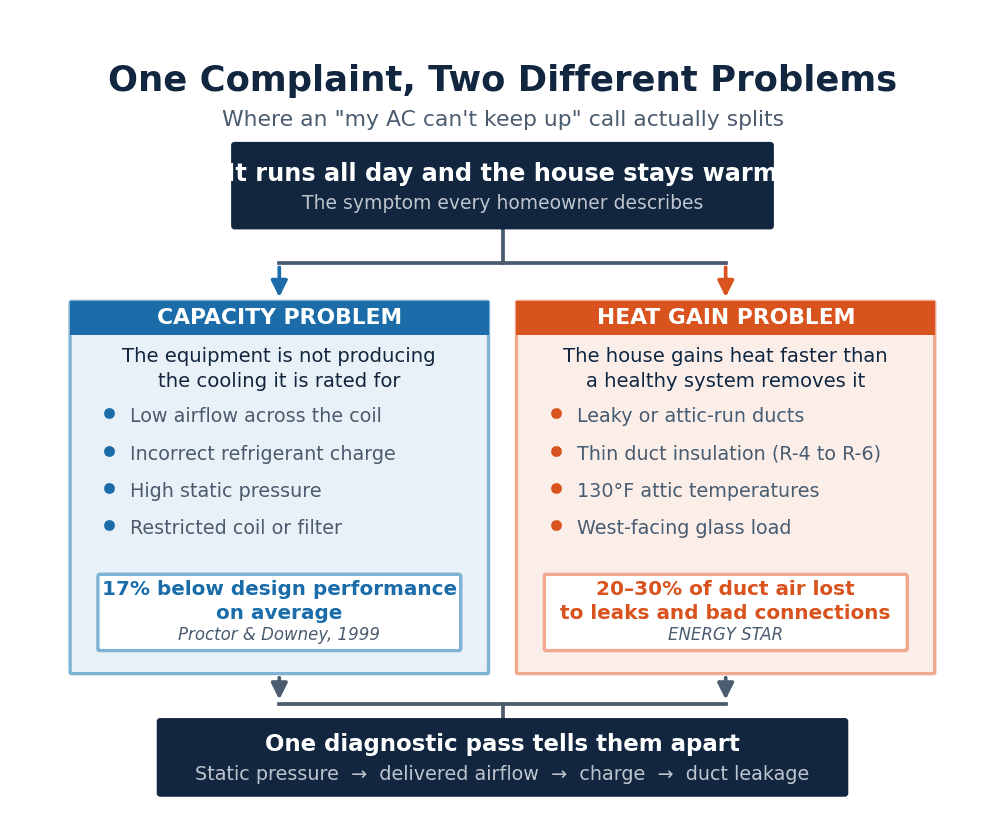
The two problems behind one complaint. Sources: Proctor and Downey (1999), ENERGY STAR.
Capacity side vs. heat gain side, compared
| Capacity problem | Heat gain problem | |
| What’s wrong | Equipment isn’t producing rated cooling | House absorbs heat faster than the system removes it |
| Common findings | Low airflow, incorrect charge, restricted coil, high static pressure | Leaky or attic-run ducts, thin duct insulation, west glass, poor attic conditions |
| Supporting data | 50 to 67% of ACs have improper charge or airflow (Proctor and Downey, 1996) | 25 to 40% of energy lost in attic or crawlspace ducts (NREL) |
| Typical symptom | Long runtimes, weak supply temperature split, iced coil | Certain rooms far warmer than others, worst in late afternoon |
| Fixed by | Airflow correction, leak repair and proper charge, coil or blower service | Duct sealing or rerouting, insulation, load-based redesign |
| Can the homeowner verify? | No | No, aside from logging indoor humidity |
Why Your AC Can Run All Afternoon and Still Drift Above Setpoint
Sometimes nothing is broken. Residential equipment is sized using ACCA Manual J, which uses the 1% summer design dry-bulb temperature, meaning a condition that outdoor temperatures exceed roughly 1% of annual hours by definition.
So on the hottest afternoons of a Tulsa summer, a correctly sized, healthy system is expected to run continuously and may sit a degree or two above your setting. That’s design behavior, not failure.
Actionable step: ask your contractor what design temperature the Manual J for your home used. We don’t publish a fixed number for this area, because the honest answer comes from your load calculation, not from a blog post.
For scale on how often that matters here: NWS Tulsa’s 1991 to 2020 normals show 10.8 days per year at or above 100°F, with 4.4 in July and 5.3 in August. The record streak is 22 consecutive 100-degree days, ending August 28, 1936. NOAA’s Climate Prediction Center outlook for summer 2026 leans toward above-normal temperatures across Oklahoma, so a system that barely held on last year may be more noticeable this year.
Why Your House Feels Clammy When the Thermostat Says 74
Because your AC has two jobs, and one of them is invisible on a thermostat.
Sensible cooling lowers the thermometer reading. Latent cooling removes moisture from the air. In an Oklahoma summer, humidity forces your system to split its tonnage between the two, which slows how fast the temperature drops per minute of runtime.
If your thermostat reads 74°F and the house still feels wrong, the issue may be moisture, not capacity. The EPA recommends keeping indoor relative humidity between 30% and 50%, and notes that above 60% RH, mold, dust mites, cockroaches, and bacteria all become much more viable indoors. ASHRAE Standard 55 targets a 30 to 60% band for comfort.
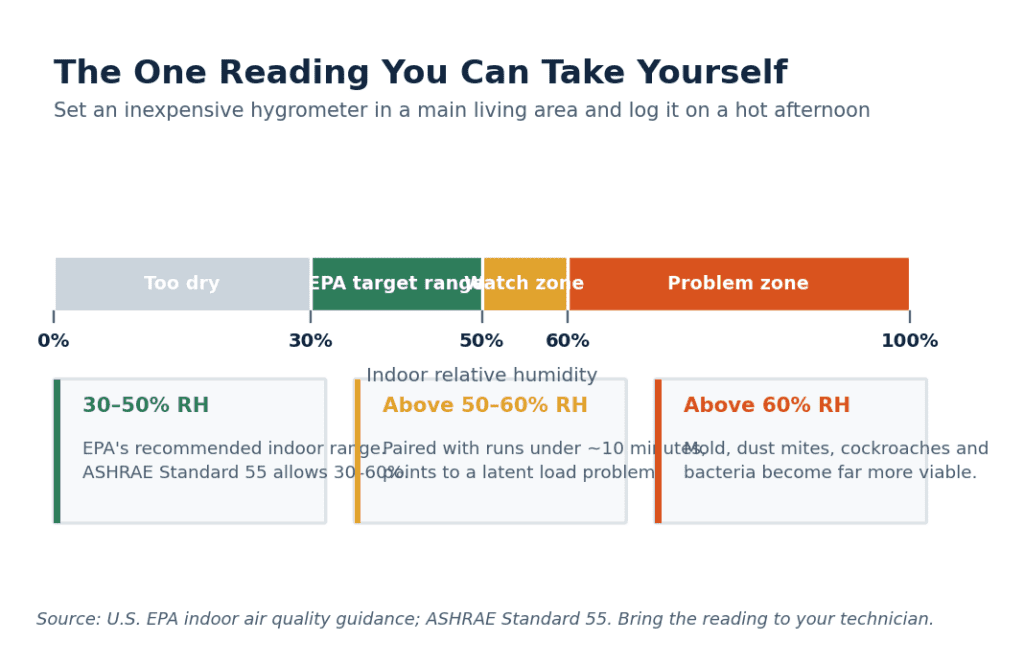
Indoor humidity targets from EPA guidance and ASHRAE Standard 55.
Signs that dehumidification is eating your capacity:
- Short runs, often under about 10 minutes at a time
- Summer indoor humidity readings above 50 to 60%
- Fabrics, bedding, or towels that feel damp
- Air that feels cool at the vent but heavy in the room
The one thing you can measure yourself: buy an inexpensive hygrometer, set it in a main living area, and log the reading a few times on a hot afternoon. The EPA points out that humidity levels can be checked with a low-cost meter. Bring that number to your technician. It changes the diagnosis, and it’s the only test on this page that doesn’t need certification or equipment.
Would a Bigger AC Unit Fix This?
Usually no, and it can make the humidity worse.
An oversized system drops the air temperature quickly and shuts off before it completes a full dehumidification cycle. The air feels cool, the moisture stays, and the house still feels off. That’s why a latent-load problem misread as a capacity problem often leads to a larger replacement that leaves the homeowner less comfortable than before.
Why Two Houses on the Same Street With the Same Unit Feel Different
Duct location, duct insulation, attic conditions, and window orientation.
The Florida Solar Energy Center, working from measured attic data across 21 monitored homes for ASHRAE Special Project 152P, published a worked calculation worth understanding. With a peak attic temperature of 130°F and 78°F held indoors, ceiling heat gain came to 3,500 Btu/hr. With R-5 ducts in that attic and 57°F supply air, heat gain to the duct system came to 7,300 Btu/hr under design conditions, more than twice the ceiling flux.
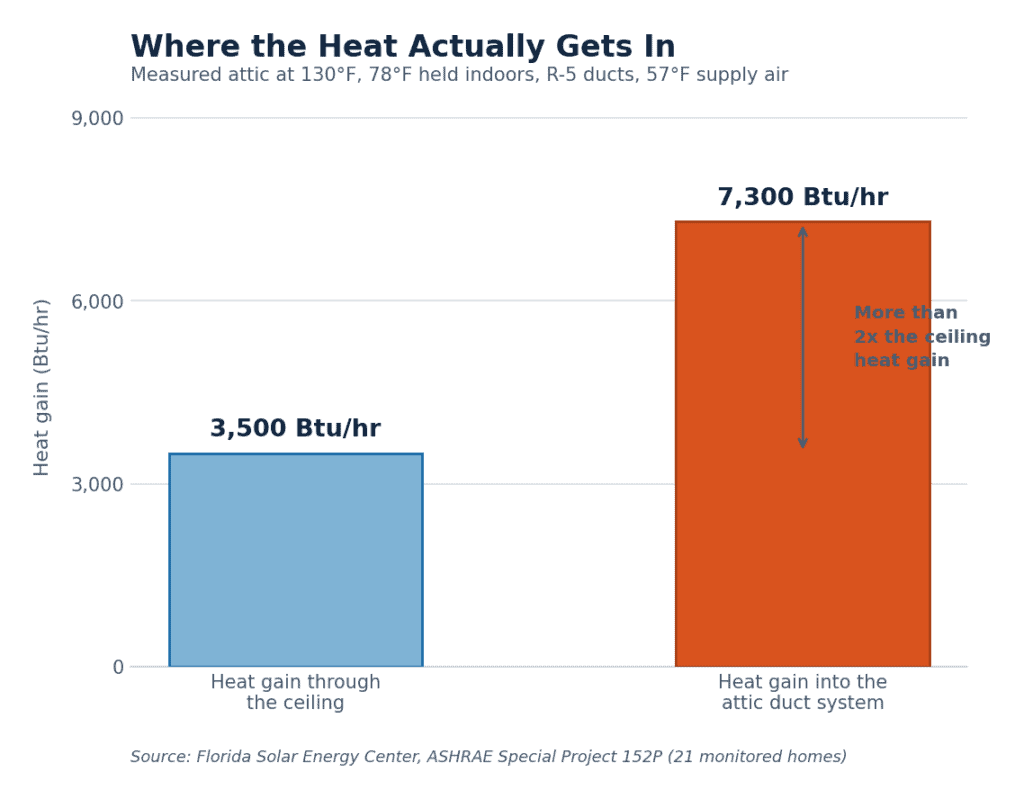
Florida Solar Energy Center, ASHRAE Special Project 152P, 21 monitored homes.
FSEC also documents that attic ducts are typically insulated only to between R-4 and R-6, and has measured attic air above 130°F in an occupied home that already had a radiant barrier.
Put plainly: two identical units, one with ducts in a hot attic, will not perform the same. A 3-ton system moving 1,200 CFM that loses 25% of its air is giving up about three-quarters of a ton of cooling before it ever reaches a room.
Windows matter too. The U.S. Department of Energy attributes 25% to 30% of residential heating and cooling energy used to heat gain and loss through windows. West-facing glass takes the worst of it during the late-afternoon stretch, which is exactly when most “it can’t keep up” calls come in.
What is Static Pressure, and Why Does a Technician Measure it First?
Static pressure is the resistance air meets as it moves through the ducts, filters, coils, and blower, measured in inches of water column (in. w.c.). High static pressure is evidence of low airflow.
Field data from the National Comfort Institute found that while most residential systems are rated for about 0.50 in. w.c. of total external static pressure, the average measured in U.S. homes is 0.82.
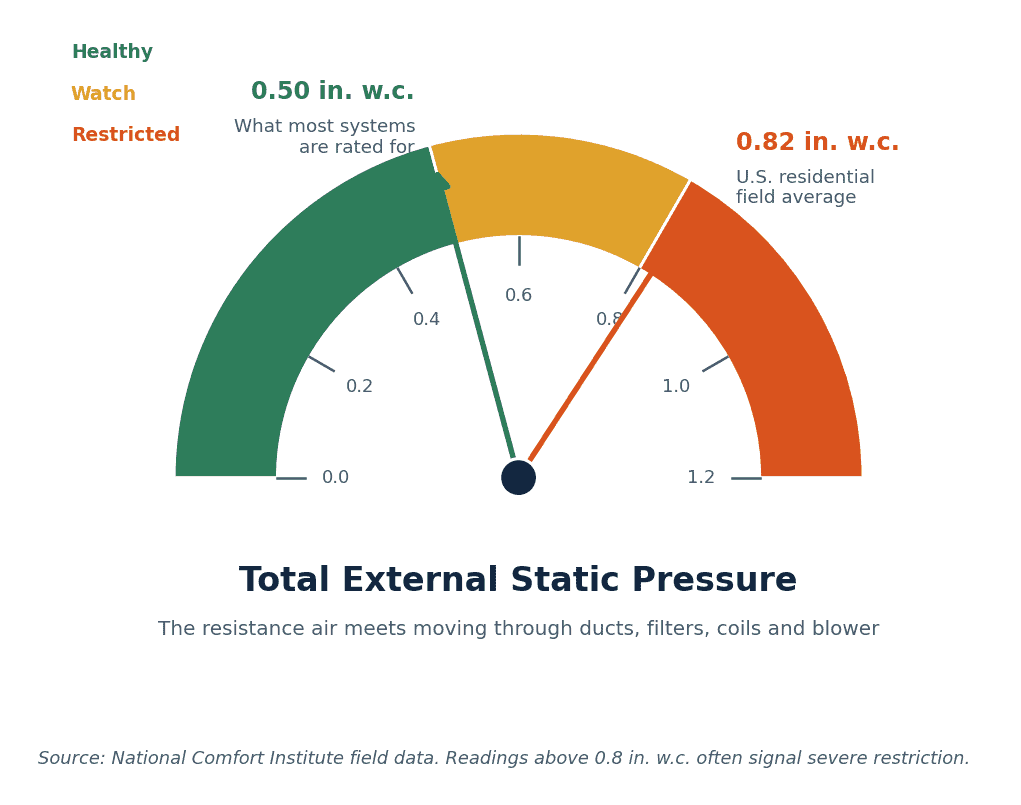
Rated versus measured total external static pressure. Source: National Comfort Institute field data.
The late Rob “Doc” Falke, technical director at the National Comfort Institute, described that gap in terms most people remember: translated into blood pressure numbers, a national average like that would read as something close to 130 over 200. He also observed that duct systems are left out of the large majority of service agreements, which is part of why the problem stays hidden. (Paraphrased from Falke’s published technical writing for NCI.)
Common causes of high static pressure include blockages, closed dampers, poor transitions and offsets, kinked flex duct, restrictive high-efficiency coils, and restrictive filters. Readings above 0.8 in. w.c. often point to severe restriction and can shorten blower motor life.
There’s a second reason this test comes first. Below 350 cfm per ton, the standard tests used to determine refrigerant charge become invalid. That’s why a visit where someone “added a pound of refrigerant” without checking airflow often doesn’t fix anything. If you’ve had that happen and you’re unsure whether the last diagnosis was complete, this is the moment to ask for a full measurement pass rather than another top-off.
Does Closing Vents in Unused Rooms Help Your AC Keep Up?
No. Closing supply vents raises static pressure and cuts airflow across the coil.
Restricting airflow can drop coil temperature far enough to freeze the evaporator, which blocks airflow entirely and risks liquid refrigerant returning to the compressor. It’s one of the most common well-intentioned changes we find on service calls, and it works against the system every time.
Do You Have to Replace Your R-410A System Because of the 2026 Refrigerant Rules?
No, and a lot of content published in 2025 now states this incorrectly.
Here’s the current picture as of July 2026:
- Under the 2023 Technology Transitions Rule, EPA prohibited manufacture of components for new residential and light commercial systems on or after January 1, 2025.
- On May 21, 2026, EPA finalized changes removing the January 1, 2026 installation deadline for residential and light commercial AC and heat pump systems using refrigerants above 700 GWP, as long as the equipment was manufactured or imported before January 1, 2025.
- Contractors and distributors can keep installing existing pre-2025 R-410A inventory until it runs out.
- Before that final rule, EPA had issued an enforcement statement in December 2025 deprioritizing the installation deadline. HARDI’s CEO Talbot Gee described that move as good news for distributors and contractors heading into the new year, given how much members needed certainty (paraphrased from his public statement).
What it means for you: existing R-410A systems can still be serviced, repaired, and recharged. New equipment is being built for A2L refrigerants. For context, R-410A carries a GWP of 2,088, while R-454B is 466 and R-32 is 675. The phasedown comes from the American Innovation and Manufacturing Act of 2020, which directs EPA to cut HFC production and consumption 85% over fifteen years, stepping down 40% below baseline through 2028, then 70% from 2029 to 2033.
The practical takeaway is about availability and long-term service cost, not forced replacement. Ask your contractor which refrigerant your system uses and what the service outlook looks like for it.
Can You Add Refrigerants Yourself?
No. Connecting gauges, pressure-testing, and adding refrigerant all fall inside EPA’s definition of regulated technician work under Section 608.
Anyone purchasing refrigerant for a stationary appliance, or handling refrigerant at all, must hold 608 certification. The Clean Air Act prohibition on knowingly venting refrigerants, including HFCs, remains in force.
AHRI’s guidance to equipment owners is worth following: require your technician to locate and repair leaks rather than top off a leaking system. EPA requires repair of substantial leaks. Undercharge also does real damage over time, producing low evaporating pressures, evaporator icing, and shortened equipment life.
One more current detail: A2L refrigerants require A2L-rated recovery equipment and A2L-rated leak detectors. Standard A1 recovery machines used for R-410A aren’t certified for A2L work, and technicians need updated training to handle those refrigerants safely.
How to Confirm Your Oklahoma HVAC Contractor is Licensed
Use the state verification tool at cibverify.ok.gov.
The Oklahoma Construction Industries Board licenses HVAC and mechanical trades statewide under Title 59 §1680.2, the Mechanical Licensing Act. Tulsa and Oklahoma City accept the CIB credential, and there’s no separate municipal HVAC license.
A few things worth knowing before you let anyone open a panel or a plenum:
- Performing heating, air conditioning, and refrigeration work in Oklahoma requires a license, or registration as an apprentice under a licensed contractor.
- An HVAC/R Limited Contractor license covers cooling equipment up to 25 tons and heating up to 500,000 Btu/h per appliance. Unlimited has no cap.
- Mechanical contractors must carry a $5,000 corporate surety bond payable to CIB and show a certificate of insurance with at least $50,000 commercial general liability.
- CIB verification shows license status, type, and expiration date.
The same rule applies to the other trades in your home. Electricians and plumbers must be licensed or registered through CIB too, which is worth checking before anyone touches a service panel during an equipment swap. If your project touches wiring, disconnects, or a new circuit, our licensed electrical work side handles that piece under the same credential.
The Quality Split Test: How We Tell Capacity From Heat Gain
The Quality Split Test is a single diagnostic pass that determines whether a “can’t keep up” call is a capacity problem or a heat gain problem, by measuring static pressure, delivered airflow, refrigerant charge, and duct leakage before anything gets replaced.
Here’s what each measurement tells us, and why it isn’t something you can run at home.
| Diagnostic | What it reveals | Why it needs a technician |
| Total external static pressure | Whether the ducts are choking the blower. Rated around 0.50 in. w.c.; U.S. field average is 0.82 | Needs a manometer plus test ports at correct locations, and the rated ESP from the data plate |
| Airflow verification (cfm/ton) | Whether the coil gets the air it needs. Below 350 cfm/ton, charge tests are invalid | Needs a flow hood, TrueFlow grid, or plenum-pressure method plus manufacturer blower tables |
| Charge verification (superheat/subcooling) | Whether the system holds its designed charge. Only 38% of 4,000+ tested systems did | Regulated under EPA 608, and invalid until airflow is confirmed |
| Duct leakage testing | Whether cooled air reaches rooms or dumps into the attic. Typical loss is 20 to 30% | Needs a calibrated duct blower; total leakage and leakage-to-outside are different numbers |
| Room-by-room Manual J plus delivered airflow | Whether the imbalance is equipment, distribution, or the building itself | Requires measured walls, windows, insulation, roof, and local climate data |
| Indoor RH logging | Separates a latent-load problem from a capacity problem | You can take the reading. Interpreting it and correcting it is the technical part |
Notice the order. Airflow before charge, every time. That sequence is the difference between a repair that holds and a repair that gets repeated next August.
Frequently Asked Questions
How hot does a Tulsa attic actually get? Measured research from the Florida Solar Energy Center recorded attic air above 130°F, including in an occupied home that already had a radiant barrier. We use the measured figure rather than the 150°F number that circulates online, because 130°F is what the monitoring supports.
Is it normal for my AC to only cool the house so far below the outdoor temperature? There’s no reliable fixed rule for this, and any number you see quoted varies with humidity and equipment. What’s meaningful is the supply and return temperature split measured alongside verified airflow. Have a technician take both readings together, because either one alone can mislead.
My AC runs constantly. Is that always a problem? Not always. At peak design conditions, continuous runtime is what a correctly sized system is supposed to do. It becomes a concern when it happens on mild days, when rooms are uneven, or when indoor humidity stays high.
How much cooling do leaky ducts really cost me? A 3-ton system moving 1,200 CFM that loses 25% is giving up about three-quarters of a ton. NREL estimates that systems with ducts in attics or crawlspaces lose 25% to 40% of the energy passing through them, and Lawrence Berkeley National Laboratory field surveys put the average closer to 22% of air-handler flow, with attic and crawlspace systems regularly above 35%.
Should I repair or replace? That depends on the measured system condition, age, refrigerant type, and what inventory is available. We won’t guess at it in print. Ask for a diagnostic and a written estimate that shows the measurements behind the recommendation.
Is my duct system worth sealing, or does it need replacement? That requires leakage testing plus a visual inspection of the runs, joints, and insulation levels. Sealing solves some situations; poor routing, undersized trunks, or crushed flex often don’t respond to sealing alone.
What will this cost? Cost depends entirely on what the diagnostic finds, which is why we don’t publish figures. Request a diagnostic visit and a written estimate.
Get the Measurements Before You Buy Anything
If your house isn’t holding temperature this summer, the useful next step isn’t a new unit. It’s a set of numbers: static pressure, delivered airflow, charge verified in the right order, duct leakage, and an indoor humidity reading you can take yourself today.
Quality Heating, Cooling, Plumbing & Electric serves homes across the Tulsa metro, including Broken Arrow, Owasso, Bixby, Jenks, Sand Springs, Sapulpa, Claremore, Bartlesville, Muskogee, and the surrounding communities. We’re CIB licensed, and you’re welcome to verify us at cibverify.ok.gov before we ever knock on the door.
Call us to schedule a Quality Split Test diagnostic and get a written estimate based on what we measured, not what we assumed.


