



Quick answer: If only one toilet clogs and every other drain in the house works fine, the problem is almost always inside that toilet. If tubs gurgle, sinks drain slowly, or a second toilet starts acting up, the blockage sits past the toilet in the drain or sewer line. A plunger can clear the first kind. It will never fix the second.
That single distinction saves people a lot of wasted weekends. At Quality Heating, Cooling, and Plumbing, we get calls from folks in Tulsa, Owasso, and Sapulpa who have plunged the same toilet six times in three weeks and can’t figure out why it keeps coming back. Nine times out of ten, nobody ever checked whether the rest of the house was trying to send a signal.
Below is the side by side breakdown we use on service calls, plus the at home observations you can make in about five minutes. If those observations point downstream, that’s when it makes sense to bring in professional plumbing services instead of buying another plunger.
Why Does My Toilet Keep Clogging? Two Very Different Problems
A toilet that clogs once in a while is usually nothing. Too much paper, a bad day, move on.
If your toilet keeps clogging, the problem may go beyond the toilet itself. The issue may be either inside the porcelain or past it. Those two categories need completely different fixes, and treating one like the other is why repeat clogs feel unsolvable.
Toilet Problem or Drain Problem? Compare What You’re Seeing
Here’s the comparison table. Read down whichever column matches your house.
| What you notice | Points to the TOILET | Points to the DRAIN or SEWER |
| How many fixtures are affected | Only one toilet clogs | Multiple toilets clog, or a second bathroom acts up |
| Other drains in the house | Sinks, tubs, and showers drain normally | Several sinks or tubs drain slowly |
| Sounds | Quiet flush, just weak | Gurgling from tubs, sinks, or other toilets |
| Smell | Normal | Sewer odor near drains or outside |
| After you plunge | Stays clear for weeks or longer | Backs up again within days |
| What triggers it | Heavy toilet paper use | Happens with normal, light use |
| Water behavior | Bowl fills high, drains slowly, then settles | Water backs up into a different fixture entirely |
| Yard clues | None | Soggy, unusually green, or sunken patches along the sewer route |
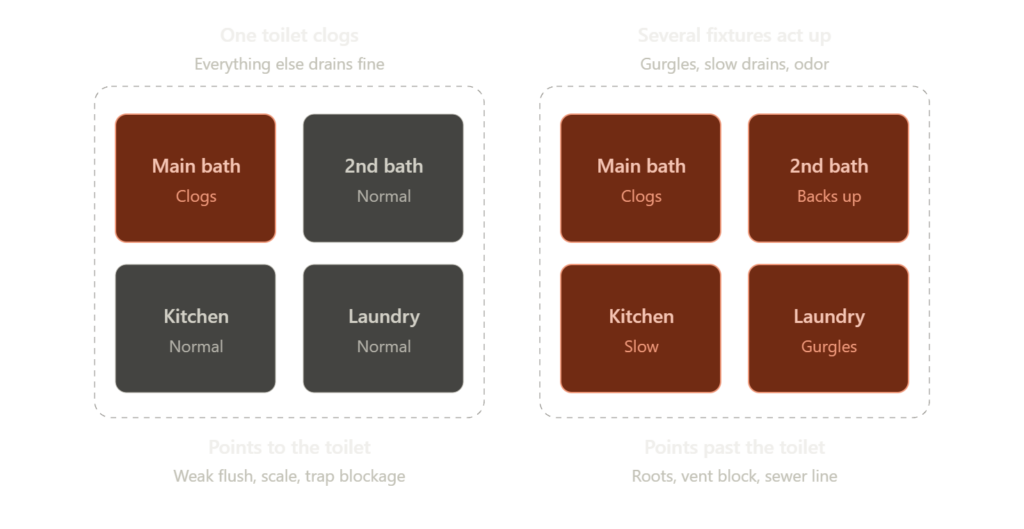
A simple two panel graphic showing a single bathroom lit up (toilet issue) versus a whole house floor plan with multiple fixtures lit up (drain issue).
What Causes Clogs Inside the Toilet Itself?
Three things account for most of them.
An older low flow toilet. This one surprises people. The Energy Policy Act of 1992 set the federal maximum at 1.6 gallons per flush, effective in 1994. Before that, toilets used 3.5 to 5 gallons. Those first generation 1.6 gallon models had a reputation as poor flushers, and manufacturers later fixed it by enlarging tank outlet holes and widening the internal passageways so waste could clear. So a mid 1990s toilet gets the worst of both eras: low water volume with the old narrow design. If your home still has one, that’s a real suspect.
Modern high efficiency models flipped the script. The EPA notes that WaterSense labeled toilets use 1.28 gallons per flush or less, about 20 percent below the federal standard, while delivering equal or better performance. They also have to clear MaP testing, commonly at 600 grams of solid waste in a single flush, before they earn the label. Oklahoma has not adopted a statewide 1.28 gallon mandate, so 1.6 gallons per flush remains the federal ceiling here. The efficiency label is a choice, not a requirement.
Hard water scale. Scale collects in two spots that quietly kill flush power: the small rinse jets under the rim and the trapway. The trapway is the curved channel molded into the back of the bowl that carries waste out. As the rim jets crust over, less water enters as a swirl, so the flush loses the spin that pushes waste along. As scale narrows the trapway, the opening shrinks a little more each year. Nothing dramatic ever happens. The flush just gets weaker until loads that used to clear start hanging up.
A partial trap blockage. The trap catches things before they reach the main line, which is exactly its job. When an object or a wad of paper lodges there and stays, every flush afterward has less room to work with. It clogs, you clear the surface, it clogs again.
What Causes Clogs Past the Toilet?
Tree roots, and this is the big one. A research review published by the USDA Forest Service reports that roots are behind more than half of all sewer blockages, with old jointed pipe, shallow pipe, small diameter pipe, and fast growing tree species all raising the odds.
Now the part most homeowners have backwards:
North Carolina State Extension makes a point worth repeating. Roots cannot crack a sewer pipe. They can only slip into a crack or gap that already exists. If roots are in your line, the pipe was already leaking, usually because old clay tile or cast iron had started breaking down. The tree found the problem. It did not create it.
Once inside, roots thicken and behave like a net, catching paper and debris that would otherwise pass. That’s the mechanism behind the most frustrating symptom of all: the clog that comes back within days of being snaked. The auger punches a hole through the mass, water flows for a little while, then the same net catches the next load.
Homes across our service area in Sand Springs, older parts of Broken Arrow, and Sapulpa often sit on pre 1980s clay or cast iron laterals with mature trees overhead, which is the exact risk profile that review describes.
A blocked vent. Your plumbing has vent stacks running up through the roof so air can move freely behind draining water. When debris, a bird’s nest, or ice blocks one, the system pulls a vacuum and siphons water back down the lines. That’s what causes the gurgling you hear from a tub when you flush a toilet in another room. Air is being dragged through the nearest available trap.
Wipes and non flushables. The word flushable does a lot of unearned work on those packages. The FTC has never legally defined the term or set rules for using it. The evidence from the wastewater side is not subtle: the National Association of Clean Water Agencies has estimated that flushed wipes add roughly $441 million a year in operating costs for North American utilities, with broader estimates running from $500 million to $1 billion annually. A 2017 Water UK study found wipes made up 93 percent of the material blocking sewers. And the Responsible Flushing Alliance’s 2024 national survey found 53 percent of Americans admitted flushing something they knew they shouldn’t.
There’s movement on labeling too. The bipartisan WIPPES Act would create a national standard requiring clear Do Not Flush labeling on non flushable wipes, built on laws already passed in seven states.
Not sure which column you’re in? Our team runs camera inspections as part of drain cleaning and sewer services in Tulsa, which is the only way to see what’s actually sitting in the line. Call Quality Heating, Cooling, and Plumbing at 918-393-4577 and we’ll take a look.
The Cost of Guessing Wrong Isn’t Just Inconvenience
This is the part that rarely comes up until it’s too late. According to the Insurance Information Institute, most homeowners and business policies do not cover sewer backup unless that specific coverage has been added to the policy. The Institute also notes that homeowners are generally responsible for the sewer lateral, the buried pipe running from the city main to the house. If that lateral cracks, collapses, or fills with roots, the repair usually lands on the owner.
Sewer backups are also becoming more common. Figures cited by the Civil Engineering Research Foundation put the increase at about 3 percent more homes each year.
We don’t publish repair prices because the number depends entirely on where the blockage is and what’s causing it, and a quote we posted last year could be wrong today. What we can tell you plainly is that a small toilet repair will never resolve a main line problem, so the diagnosis is what determines the bill. Check your own policy with your insurer, and call us for an exact quote on your situation.
When Should You Stop Plunging and Call a Plumber?
Stop and pick up the phone if any of these are true:
- More than one fixture is slow, backing up, or gurgling
- The clog returns within days of being plunged or snaked
- You smell sewage near a drain or in the yard
- Water appears somewhere else when you flush, like a tub filling slightly
- The toilet water level rises and falls on its own between uses
Each of those points past the porcelain. A camera inspection shows roots, cracks, offsets, and collapsed sections directly, which is how you find out whether you’re dealing with a simple cleaning or a damaged lateral. Guessing that answer is expensive in both directions.
Frequently Asked Questions
Why does my toilet clog again right after I snake it? Because the auger usually opens a channel through an obstruction rather than removing it. Root masses and partial blockages stay in place and catch the next load. Repeat clogs after clearing are one of the stronger signs the problem is in the line, not the fixture.
Do old low flow toilets really clog more than new ones? The early 1.6 gallon models from the mid 1990s had a genuine reputation for weak flushing before manufacturers widened the internal passageways and tank outlets. Today’s WaterSense models use 1.28 gallons or less and must pass MaP testing at around 600 grams of waste per flush. Water volume alone isn’t the issue. Design is.
Are flushable wipes safe to flush? The FTC has not legally defined the term, so the label is not a certification of anything. Utility data tells the other side of the story, including a Water UK finding that wipes accounted for 93 percent of sewer blocking material. We recommend the trash can.
Why do my other drains gurgle when I flush? Air is being pulled through the nearest trap because it can’t move normally through the vent stack or because a main line blockage is restricting flow. Either way, gurgling in a second fixture means the issue isn’t confined to the toilet.
Will a plunger ever fix a sewer line clog? No. A plunger works on pressure inside the trapway of one fixture. It has no effect several feet down a shared line, and repeated plunging on a backed up system can push contaminated water into other fixtures.
Does homeowners insurance cover a sewer backup? Usually not without an added endorsement, according to the Insurance Information Institute, and the lateral itself is typically the homeowner’s responsibility. Confirm the details with your own insurer before you need them.
Can a camera inspection tell me exactly what’s wrong? It shows the interior of the line, including root intrusion, cracks, offsets, and collapses, along with the location. That’s what turns a guess into a plan.
Get an Answer Instead of Another Plunger
If your toilet keeps clogging and the rest of the house is quiet, you’re likely looking at a fixture problem. If the house is talking back with gurgles, slow tubs, or odors, the answer is buried in the yard and no amount of plunging will reach it.
Quality Heating, Cooling, and Plumbing has served Northeast Oklahoma since 2014, from Bartlesville and Claremore down through Glenpool, Jenks, Bixby, Muskogee, and Okmulgee. We’re licensed in Oklahoma for plumbing under #007333, and we answer the phone around the clock for emergencies. Our Home Promise Club also includes an annual plumbing evaluation, which is a reasonable way to catch a failing line before it becomes a backup.
Call 918-393-4577 or book online, and we’ll tell you which side of that table you’re actually on.


